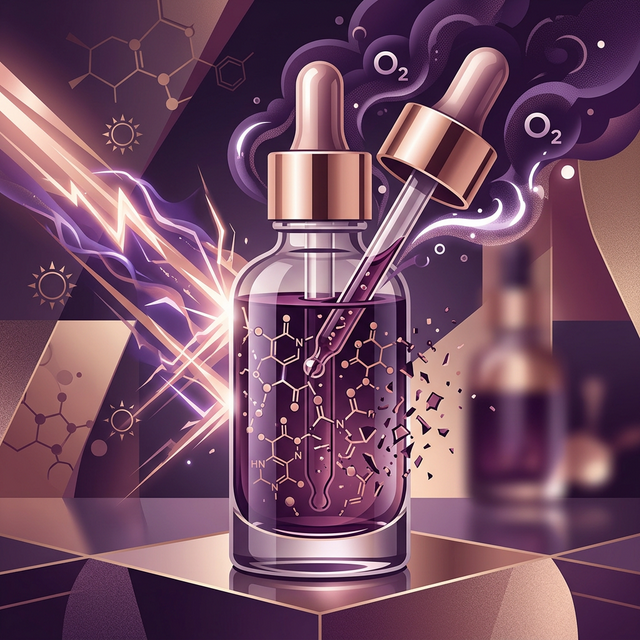
The active ingredients in skincare products are the molecules responsible for delivering the therapeutic or cosmetic benefit promised on the label. Whether the product claims to reduce wrinkles, brighten skin tone, or treat acne, the active ingredient is the functional agent that makes the product work. However, many of the most effective active ingredients in modern skincare are also among the most chemically unstable, degrading rapidly when exposed to common environmental stressors such as oxygen, light, heat, water, and incompatible pH conditions. Understanding the mechanisms of degradation and the formulation strategies that prevent it is essential for both consumers evaluating product quality and formulators developing effective cosmetic products.
What Are the Most Common Types of Ingredient Degradation?
Chemical degradation of active ingredients occurs through several well-characterized reaction pathways. Oxidation is the most prevalent mechanism, affecting a wide range of cosmetic actives including ascorbic acid (Vitamin C), retinol (Vitamin A), tocopherol (Vitamin E), and polyphenolic antioxidants such as those found in green tea, grape seed, and turmeric extracts. Oxidation occurs when a molecule loses electrons, typically through interaction with atmospheric oxygen or reactive oxygen species generated by UV light exposure. The visual signature of oxidation is often a color change; a Vitamin C serum turning yellow or brown is a textbook indicator that the ascorbic acid has oxidized to dehydroascorbic acid and subsequently to biologically inactive diketogulonic acid. Hydrolysis is another major degradation pathway, particularly relevant for ester-based actives such as retinyl palmitate and ascorbyl palmitate, where water molecules cleave the ester bond, releasing the constituent acid and alcohol. Photodegradation occurs when UV or visible light provides sufficient energy to break chemical bonds or initiate radical chain reactions, and is particularly destructive to retinoids, which absorb strongly in the UV-A range.
Why Is Retinol So Difficult to Stabilize?
Retinol exemplifies the stability challenge in cosmetic formulation. It is one of the most clinically validated anti-aging ingredients, with decades of peer-reviewed evidence demonstrating its ability to stimulate collagen synthesis, accelerate cellular turnover, and reduce the appearance of fine lines and photoaging damage. Yet retinol is exquisitely sensitive to oxidation, photodegradation, and thermal decomposition. Studies published in the Journal of Cosmetic Dermatology have shown that retinol in a typical cosmetic formulation can lose over 50% of its potency within eight weeks of light exposure at room temperature. The molecule's conjugated polyene structure, which is responsible for its biological activity, also makes it highly susceptible to radical-initiated degradation. This creates a paradox: the chemical feature that makes retinol effective is the same feature that makes it unstable. Formulators must shield retinol from every environmental insult during manufacturing, storage, and consumer use, which requires sophisticated encapsulation, airless packaging, and careful selection of the surrounding formulation matrix.
How Does pH Affect Active Ingredient Stability?
The pH of a cosmetic formulation profoundly influences the stability and efficacy of active ingredients, and getting it wrong is one of the most common formulation errors. L-ascorbic acid, the most bioavailable form of Vitamin C, requires a pH below 3.5 to maintain its protonated form, which is the only form capable of penetrating the stratum corneum. However, at these low pH values, many other common cosmetic ingredients become unstable. Niacinamide (Vitamin B3), for example, undergoes hydrolysis to nicotinic acid at pH values below 4.0, and the resulting nicotinic acid can cause flushing and irritation. Combining Vitamin C and Niacinamide in the same formula requires careful pH balancing to maintain the stability of both ingredients simultaneously, or temporal separation through application order recommendations. Alpha-hydroxy acids (AHAs) such as glycolic and lactic acid function optimally at pH 3.0 to 4.0, but at these pH values they can destabilize preservative systems that were designed to function at higher pH ranges, creating a microbiological safety risk.
What Formulation Strategies Prevent Degradation?
Modern cosmetic science employs multiple complementary strategies to protect unstable active ingredients. Encapsulation technologies, including liposomes, nanostructured lipid carriers, cyclodextrin complexes, and polymer microspheres, physically isolate active molecules from degradation triggers by surrounding them with protective shells. Liposomal encapsulation of retinol, for example, can extend its stability by several months compared to unencapsulated retinol in the same base formula. Antioxidant systems, consisting of primary antioxidants such as tocopherol and secondary antioxidants such as ascorbyl palmitate and BHT, scavenge free radicals before they can attack the primary active ingredient. Metal chelators such as EDTA and phytic acid sequester transition metal ions like iron and copper that catalyze oxidative degradation through Fenton chemistry. Anhydrous (water-free) formulations eliminate hydrolysis as a degradation pathway and are particularly effective for stabilizing retinol, vitamin C derivatives, and moisture-sensitive botanical extracts. Packaging design is the final defense layer, with airless pump bottles preventing oxygen exposure, opaque or amber-colored containers blocking photodegradation, and single-dose ampoules eliminating the repeated air exposure that occurs every time a jar is opened.
How Can Consumers Identify Degraded Products?
While some forms of degradation are invisible without laboratory analysis, many produce observable changes that consumers can use to evaluate product quality. Color changes are the most reliable visual indicator; Vitamin C serums should be clear to pale straw-colored, and any progression toward yellow, amber, or brown indicates significant oxidation. Texture changes in creams and lotions, such as graininess, separation, or watering out, indicate emulsion instability that may also be affecting active ingredient integrity. Odor changes, particularly the development of rancid or off-notes in oil-based products, suggest lipid oxidation that likely extends to oil-soluble active ingredients. Changes in product performance, such as a retinol product that previously caused mild tingling or peeling but no longer does, can indicate that the active ingredient has degraded below its effective concentration. Consumers should also pay attention to the Period After Opening (PAO) symbol on cosmetic packaging, represented by an open jar icon with a number indicating the recommended months of use after first opening.
What Role Does Computational Chemistry Play in Stability Prediction?
Computational tools are increasingly used to predict degradation pathways and design more stable formulations before physical prototyping begins. Density functional theory (DFT) calculations can compute bond dissociation energies to identify the weakest chemical bonds in an active molecule, predicting where oxidative or photolytic cleavage is most likely to occur. Molecular dynamics simulations can model the interaction between active ingredients and encapsulation materials, optimizing the selection of protective carriers for specific molecules. Machine learning models trained on accelerated stability data can predict long-term degradation rates from short-term measurements, potentially reducing the time required for stability assessment from months to weeks. These computational approaches do not replace physical stability testing, which remains a regulatory requirement, but they dramatically reduce the number of formulation candidates that fail during testing, saving both time and development costs.