Simulaite Stability Report
Curcumin Antioxidant-Excipient Benchmark
Generated: July 11, 2026 at 11:39 AM
Executive Summary
This report benchmarks Formulaite stability predictions against Kharat et al. 2020, which measured curcumin retention in oil-in-water emulsions containing different antioxidant excipients. The focus is on ranking antioxidant excipient strategies and explaining the pathway-level chemistry behind the observed stability differences.
- Key Results
- Predicted protector ranking matches Kharat et al.: Trolox > Ascorbic acid > Ascorbyl palmitate > No antioxidant.
Full five-antioxidant benchmark: 9/10 pairwise retention comparisons.
The single miss is alpha-tocopherol: predicted ≈ control rather than slightly below control, because lipophilic α-T stays in the oil phase and does not protect curcumin in this O/W system.
In practice the same formulator decision: do not include α-T in this O/W system.
Benchmark Setup
Formulaite predicts stability using quantum chemistry-informed pathway models. Degradation pathways include radical chain autoxidation, direct molecular oxidation, photodegradation, and hydrolysis if detected. Pathway kinetics are integrated with Arrhenius temperature scaling and environment corrections such as oxygen exposure, water activity, pH, packaging permeability, UV attenuation, and phase accessibility. For this benchmark, the differentiating signal is BDE-informed antioxidant protection depending on its radical-quenching chemistry and its availability in the emulsion environment.
| Parameter | Value |
|---|---|
| Literature source | Enhancement of chemical stability of curcumin-enriched oil-in-water emulsions: Impact of antioxidant type and concentration. doi:10.1016/j.foodchem.2020.126653 |
| Modeled formulation | 0.01 wt% curcumin, 10 wt% MCT oil, 1 wt% QS liquid extract, phosphate buffer context |
| Antioxidant dose | 600 µM for antioxidant type comparison |
| Parameter | Value |
|---|---|
| Aqueous phase | 5 mM phosphate buffer, pH 7.0, matching the paper method; buffered pH is retained for primary kinetics. |
| Model endpoint | Predicted total degradation rate constant K_total (s⁻¹), then relative ranking |
| Modeled pathways | Direct oxidation, radical autoxidation, photodegradation, hydrolysis if detected |
Antioxidant Ranking
Lower K means slower degradation and better stability. Literature order (all five): Trolox > Ascorbic acid > Ascorbyl palmitate > No antioxidant > Alpha-tocopherol.
| Literature benchmark | Formulaite prediction | ||||
|---|---|---|---|---|---|
| Scenario | Literature Retention | Literature K vs Control | Predicted K vs Control | Dominant Pathway | Interpretation |
| No antioxidant | 57.9% | 1.00× | 1.00× | Radical Autoxidation | Unprotected reference. |
| Trolox | 82.6% | 0.35× | 0.38× | Photodegradation | BDE-informed antioxidant protection lowers predicted degradation rate. |
| Ascorbic acid | 82.2% | 0.36× | 0.42× | Photodegradation | BDE-informed antioxidant protection lowers predicted degradation rate. |
| Ascorbyl palmitate | 79.5% | 0.42× | 0.49× | Photodegradation | BDE-informed antioxidant protection lowers predicted degradation rate. |
| Alpha-tocopherol | 52.7% | 1.17× | 1.00× | Radical Autoxidation | Oil-phase lipophile; predicted ≈ control (not protective). Same practical decision as literature: do not include. |
Literature K vs Control is derived from reported endpoint retention using first-order degradation: K ratio = -ln(retention fraction) / -ln(control retention fraction).
Storage time cancels because all rows are compared at the same endpoint.
Ranking accuracy
Full benchmark: 9/10 pairwise retention comparisons. Protector subset (excluding alpha-tocopherol): 6/6. The one fullbenchmark miss is alpha-tocopherol vs control: literature ranks α-T below control; the model predicts ≈ control because aqueous-phase inhibition is negligible — the practical recommendation (do not use α-T here) is unchanged.
What Was Calculated
| Calculation Layer | Engine Signal | Why It Matters Here |
|---|---|---|
| Antioxidant reactivity | Relative H-donor and radical-quenching strength of each antioxidant | Explains why Trolox and ascorbate reduce curcumin degradation compared with control. |
| Radical degradation | Oxygen- and antioxidant-sensitive radical pathway terms | Captures the main protective effect of antioxidant excipients. |
| Emulsion availability | Whether each antioxidant is more available to the curcumin degradation environment | Separates hydrophilic antioxidants (trolox, ascorbate) from oil-preferring species. |
| Photodegradation | Light-sensitive curcumin degradation pathway | Curcumin is chromophoric, so residual light can remain a competing pathway. |
| Total degradation rate | Combined degradation rate across modeled pathways | Used for relative K ranking against the literaturederived K ratios. |
Pathway Breakdown
The table below shows each scenario's pathway contribution to K_total. For the primary claim set, antioxidant protection suppresses radical pathways and shifts the limiting pathway balance.
| Scenario | Direct Ox. | Autoxid. | Photo. | Hydro. | Dominant |
|---|---|---|---|---|---|
| No antioxidant | 10.9% | 51.1% | 38.0% | 0.0% | Radical Autoxidation |
| Trolox | 0.0% | 0.1% | 99.9% | 0.0% | Photodegradation |
| Ascorbic acid | 2.8% | 6.8% | 90.4% | 0.0% | Photodegradation |
| Ascorbyl palmitate | 5.7% | 16.3% | 78.1% | 0.0% | Photodegradation |
| Alpha-tocopherol | 10.9% | 51.1% | 38.0% | 0.0% | Radical Autoxidation |
Mechanistic Insights
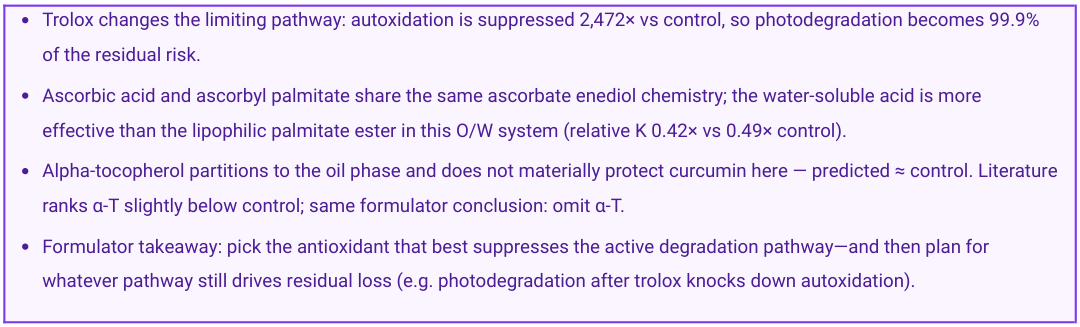
The pathway table becomes more useful when read as a mechanism shift: the unprotected formulation is co-limited by radical autoxidation and residual photodegradation, while strong antioxidant protection pushes the remaining risk toward light-driven chemistry.
Pathway-level readout
Baseline is mixed-risk: autoxidation contributes 51.1% and photodegradation contributes 38.0% of K_total.