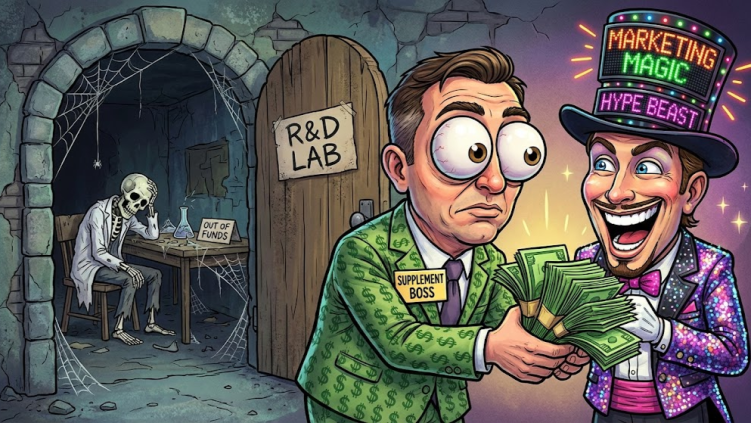
We are currently navigating the golden age of supplements where the global wellness economy is valued in the trillions and every social media feed serves as a digital showroom for the next potential metabolic hack. While it is encouraging to see such widespread engagement with personal health, peeling back the label of that viral gut health powder or trending adaptogen blend reveals a financial reality that is deeply concerning. The average high-growth supplement brand operates on a skewed capital model we call the "30/1 Rule." These companies often allocate between 30% and 40% of their revenue toward selling expenses to fund the relentless ad campaigns and influencer partnerships while frequently investing roughly 1% in actual Research & Development.
When you analyze this allocation of capital, a startling disconnect emerges where for every single dollar a brand invests in verifying that their pill actually works or is safe, they are spending roughly thirty dollars convincing you to swallow it. This creates a marketplace rich in compelling narratives but dangerously poor in scientific proof. It effectively builds an economy based on "Trust Me" rather than "Show Me."
The "Kitchen Sink" Paradox: Potent Herbs, Broken Processes
Nowhere is this disparity more dangerous than in the modern commercialization of Ayurveda and herbal supplements. It is important to clarify that polyherbal formulations are not snake oil. They are often based on powerful and time-tested combinations that have immense therapeutic potential. The problem is not the wisdom of the herbs but the recklessness of the modern drug development process.
Because the barrier to market entry is so low, we are witnessing a flood of "kitchen sink" formulations where brands simply combine ten famous herbs from ancient texts and grind them into a raw powder. A prime example is the "Tummy Rescue" archetype found on many shelves. This product typically boasts heavy hitters like Ashwagandha alongside other traditional herbs. However, even a powerhouse ingredient like Ashwagandha is destined to fail if the delivery method is fundamentally flawed.
The real cost of this low-R&D approach is not just ineffectiveness but actual biological risk. While Ashwagandha is generally safe, the "kitchen sink" approach often ignores crucial toxicity screening for other ingredients in the blend. Without rigorous pre-clinical testing, brands remain blind to the fact that herbs like Tinospora cordifolia (Giloy) can contain alkaloids that may cause hepatotoxicity and liver stress in certain populations if not chemically standardized. These formulations could be efficacious medicine, but the lack of safety protocols turns them into a gamble.
The Physics of Failure: Why 5 Grams Don't Fit in 500 Milligrams
The core of the deception lies in the critical issues of dosage and delivery. Ancient Ayurvedic texts like the Samhitas prescribed Churnas in massive doses that often ranged from 3 to 6 grams at a time. These were mixed with heavy carriers like ghee or honey to ensure absorption. In contrast, a modern vegetable capsule can only hold about 500mg. When a brand stuffs raw and unstandardized herb powder into a capsule, they are delivering barely one-tenth of the therapeutic dose required for efficacy.
They are effectively taking a protocol designed for a tablespoon and shrinking it into a pill while expecting the same physiological result. This is a physical impossibility. To make Ayurveda viable in a modern format, one must use Standardized Extracts by utilizing chemistry to concentrate the active molecules so a therapeutic dose actually fits within the capsule. Unfortunately, because extraction is expensive and raw powder is cheap, marketing-first brands skip this step and sell consumers what amounts to expensive placebo dust that never reaches the bloodstream.
Bridging the "Death Valley" of Clinical Trials
The obvious question becomes why brands do not simply prove their efficacy through clinical trials. The answer is that clinical trials represent the "Death Valley" of the supplement industry because they are slow and prohibitively expensive while carrying the risk of total failure. For a mid-sized wellness company, a single failed trial can be a bankruptcy-level event. This risk forces them to rely on safe and generic claims rather than pursuing genuine scientific validation.
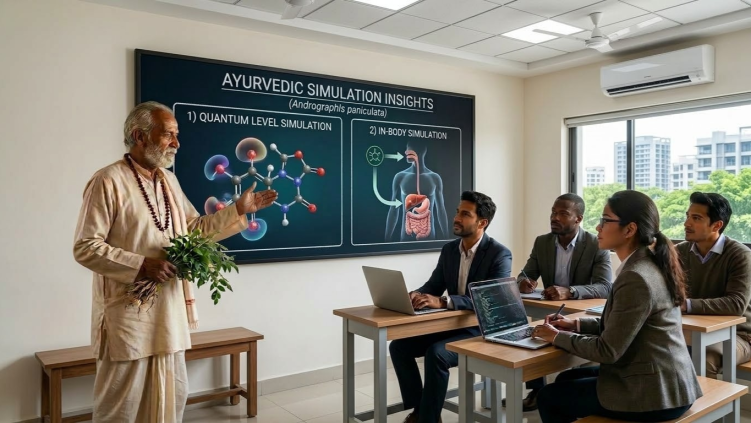
However, we cannot advance the industry without this validation because we need absolute certainty that a product lowers inflammation or protects the liver. This is where HempStreet is changing the paradigm as a true "research-to-retail" company. They have already conducted the first-ever clinical trials on cannabis for dysmenorrhea (menstrual pain) to prove their medicine works in the real world. By treating the clinical trial as the final verification step rather than the first guess, we at Formulaite utilize Digital Rehearsals to de-risk the entire process.
1. The Virtual Safety Firewall
Before a single patient is recruited, we simulate how high-potency extracts and cannabis compounds interact with human biology in an in-silico environment. We meticulously scan for silent failures such as liver toxicity signals or adverse drug-drug interactions that would typically derail a clinical trial or harm a patient. If the simulation detects a risk, we re-engineer the formula in the lab immediately. This saves millions in wasted capital and ensures patient safety.
2. The Efficacy Prediction Model
Beyond safety, we model the product's performance to solve the absorption puzzle by simulating how the standardized extract dissolves in stomach acid and whether it successfully permeates the intestinal wall. This predictive modeling allows HempStreet to enter a clinical trial with high confidence because they know the dosage is chemically correct and the bioavailability has been unlocked.
The Fuel for a Verified Future: Kapiva Innovation Fund
Transitioning from a marketing-first model to a science-first architecture is resource-intensive and technically demanding. This is why it has been so rare. This is finally changing thanks to visions such as the Kapiva Innovation Fund. By deploying serious capital specifically to fuel this kind of deep research and validation, Kapiva is setting a new standard for the entire industry. They recognize that the next unicorn in the wellness space will not be the brand with the most viral content but the brand with the most undeniable data. By investing in an ecosystem that prioritizes clinical validation and safety simulations alongside standardized efficacy, they are paving the road for a future where Ayurveda is respected not just as a cultural tradition but as a verified and reproducible science.
We are actively leaving the era of the 30% marketing budget and the dust in a capsule. We are entering the era of the standardized and clinically verified solution. It is undeniably a harder path, but it is the only one that leads to products that actually work.
References
Note: These figures are derived from "Selling, General, and Administrative" (SG&A) expenses. While this financial category includes corporate overhead alongside marketing, it is frequently a conservative estimate of true selling costs. For example, some network marketing giants exclude massive distributor commissions from this line item, meaning the actual cost of selling the product is significantly higher than even the 30% figure suggests. Sources: Herbalife Ltd. (2024). 2023 Annual Report. United States Securities and Exchange Commission, Form 10-K, 68, 89. Nu Skin Enterprises. (2024). Fourth Quarter and Full Year 2023 Results. Consolidated Statements of Income, 12(4), Table 2. USANA Health Sciences. (2024). Fourth Quarter and Fiscal Year 2023 Results. Consolidated Statements of Operations, 12(4), Table 1. National Institute of Diabetes and Digestive and Kidney Diseases. (2024). Tinospora cordifolia. LiverTox: Clinical and Research Information on Drug-Induced Liver Injury, Bookshelf ID: NBK608429. Dabur India Ltd. (2024). Integrated Annual Report 2023-24. Management Discussion and Analysis, 12–45.