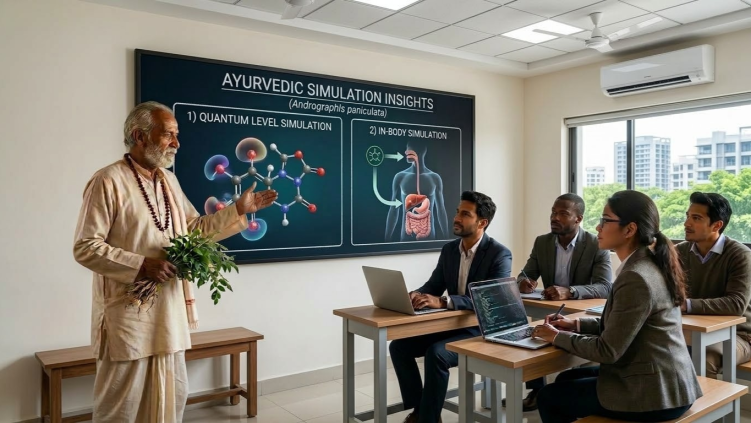
While the global dietary supplement market is heavily saturated with Ashwagandha (Withania somnifera) products, nearly all of them rely on the exact same flawed delivery mechanism: compressing raw root powder or dry spray-dried extracts into standard, water-soluble gelatin capsules.
If you analyze the classical Ayurvedic engineering detailed in the Charaka Samhita, you will notice this dry-powder approach directly violates the original formulation protocol. Historical practitioners demanded that heavy botanicals like Ashwagandha be prepared and consumed utilizing specific vehicles (Anupana), most notably warm, lipid-dense carriers like milk or purified ghee (clarified butter).
This was not a culinary preference. It was an advanced chemical engineering strategy designed to manipulate human pharmacokinetics—and modern AI simulations can now prove exactly why the ancient Vaidyas were right.
Understanding Withanolide Solubility
The primary bioactive compounds inside Ashwagandha responsible for its adaptogenic, cortisol-regulating effects are a group of steroidal lactones called Withanolides (most notably Withanolide A).
Structurally, withanolides are massive, highly lipophilic (fat-soluble) molecules. They possess extremely poor aqueous solubility. When a modern consumer swallows a dry Ashwagandha powder capsule with a cold glass of water on an empty stomach, the highly lipophilic molecules violently resist dissolving in the aqueous environment of the gastrointestinal lumen. If a molecule cannot dissolve into solution, it cannot pass through the intestinal epithelial transport walls. It simply passes through the body unabsorbed.
The Formulaite Ashwagandha Simulation
To benchmark exactly how much systemic absorption modern brands are losing by ignoring the lipid-carrier protocol, the Formulaite team ran an advanced pharmacokinetic simulation modeling the delivery of standardized Ashwagandha extract in both a fasted, aqueous state and a fed, lipid-rich state.
The digital simulation rapidly mapped the dissolution kinetics and membrane permeability of the extract across a virtual population demographic. The results mathematically validated the necessity of the ancient Anupana strategy.
The 1.8x Targeted Delivery Boost
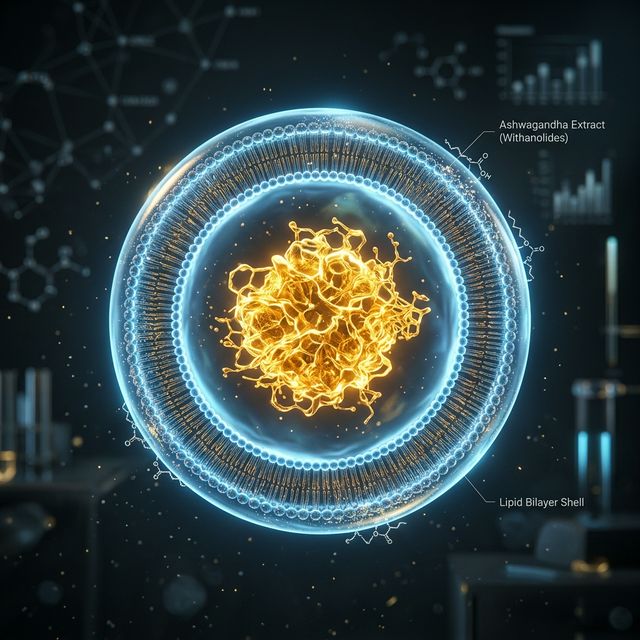
Our model showed that delivering the Ashwagandha formulation alongside a heavy lipid matrix (representing the traditional fat-dense carriers) drastically altered the solubility profile in the gut. The lipids provided a hydrophobic environment that the withanolides could readily dissolve into, acting as a biological "transport cloak."
The simulation calculated that utilizing this lipid carrier mechanism resulted in a definitive 1.8-fold (1.8x) increase in the overall bioavailability of Withanolide A.
By suspending the heavy, fat-soluble plant molecules in dietary fats, the formulation successfully smuggled the compounds past the stringent aqueous barriers of the GI tract, significantly amplifying the blood-plasma concentration of the active adaptogen.
The Precision of Biological Engineering
Even more fascinating, the Formulaite simulation demonstrated incredible biological nuance. It showed that while the lipid carrier drastically boosted the fat-soluble withanolides, it had absolutely zero enhancing effect on the water-soluble compounds present in the exact same herb.
This proves that ancient healers were using heavy dietary fats not as a generic enhancement, but as highly specific, targeted delivery mechanisms to selectively unlock exact lipophilic therapeutic molecules.
Stop Manufacturing Dry Biomass
If you are a direct-to-consumer (DTC) wellness brand formulating a premium Ashwagandha supplement, launching a standard dry powder capsule is a massive disservice to your customers. Efficacy is entirely dependent on delivery. To maximize the clinical endpoints of your adaptogenic product, you must formulate with a biological transport strategy in mind—whether that involves suspending the extract in a liquid lipid-cap, utilizing a modern liposomal/phytosomal matrix, or engineering a self-emulsifying drug delivery system (SEDDS).
However, attempting to guess the proper lipid-to-extract ratio at the lab bench can lead to wildly unstable physical emulsions and costly manufacturing delays.
The Ultimate Formulation Sandbox
Brands and CDMOs use the Formulaite Simulation Engine to run rapid, highly specific physical chemistry models before they ever scale up prototype production. You can digitally test exactly how your unique Ashwagandha matrix behaves inside the human body when mixed with various excipients, lipid carriers, and pH levels.
Don't guess on your pharmacokinetic delivery mechanisms. Simulate your formulation's exact clinical potential to guarantee you are bringing the most efficacious product to market.
References
Sources:
Ashwagandha Carrier Report: https://formulaite.ai/simulaite_ashwagandha_report.pdf
Formulaite Platform: https://formulaite.ai/#platform