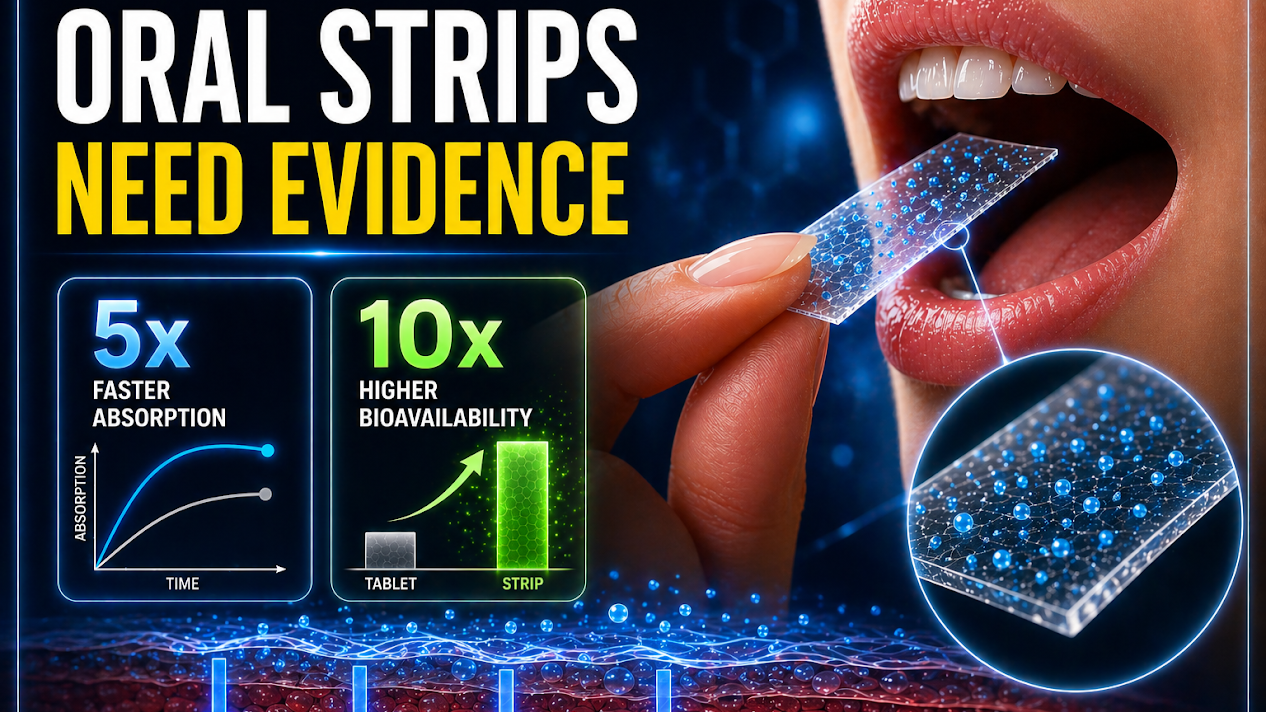
The natural wellness industry is rushing toward oral thin films as a promising format for increasing bioavailability and achieving faster onset. Yet a gap in the literature exists because few nutraceutical studies evaluate these delivery systems. This lack of clinical evidence fuels what we call the bro science of oral strips. Marketing teams often attach claims of instant absorption to new products regardless of the underlying chemistry. The narrative assumes placing any molecule in the mouth automatically enters the bloodstream because it bypasses the gut and liver. This approach ignores basic pharmacokinetics. An oral strip holds limited mass and caps out around 50 to 100 milligrams. You cannot fit three grams of raw botanical powder onto a small polymer matrix. This physical constraint dictates that the format demands concentrated extracts and predictive physics to confirm efficacy. Formulators must rely on precision dosing and physiological simulation to ensure a strip will deliver more active ingredient than an equivalent capsule or liquid tincture.
Validating Efficacy: A Resveratrol Case Study
We observe where the format succeeds by reviewing our pharmacokinetic simulation data for resveratrol. Resveratrol undergoes heavy first pass metabolism when swallowed in a traditional format. To validate our predictive models we recreated a clinical case study comparing a 34 milligram mucoadhesive buccal strip designed for sustained release over nine hours against a 2000 milligram oral powder suspension. The original physical study relied on a sample size of exactly one person but we simulated the pharmacokinetics across a virtual population of 100 diverse individuals from an American population distribution to map true physiological variance. The clinical study saw a roughly 15 fold increase in bioavailability which is highly similar to the 17 fold enhancement we predicted. The buccal strip achieved 60.5 percent bioavailability compared to 3.6 percent for the massive oral suspension. By allowing 97 percent of the dose to absorb transmucosally an oral strip can deliver more bioavailable active ingredient to the bloodstream than a raw amount that would feasibly fit inside a standard capsule with a multi-ingredient formula.
Navigating Delivery Pathways and User Behavior
Buccal and sublingual delivery pathways utilizing fast dissolving strips offer a much faster onset but rely heavily on patient behavior. Our simulation of CBD and CBN across multiple formats highlights the issue of accidental swallowing. If a patient holds the fast dissolving strip properly against the cheek or under the tongue our models show buccal strips achieve up to 78 percent bioavailability for these cannabinoids. If the patient swallows prematurely the active ingredient drops directly into the gastrointestinal tract. Natural swallowing causes the bioavailability to drop roughly four times down to 22 percent as the drug is lost to the stomach and liver. Even with this loss a swallowed strip performs significantly above standard oral tinctures and gummies which deliver less than two percent bioavailability under fasted conditions.
Our models also demonstrate that while sublingual delivery is absorbed much faster it ultimately underperforms buccal administration in total bioavailability due to a smaller surface area and higher salivary flow. The data reveals nuanced differences between compounds. CBN outperforms CBD by up to 16 percent for transmucosal routes but CBD absorbs better when swallowed. We also noted that food intake improves swallowed CBD tincture absorption by nearly five times while having virtually no effect on transmucosal delivery.
Recognizing Chemical Limitations: The Berberine Challenge
While these variations prove that simulation maps the exact mechanics of a successful formulation, it also reveals when this delivery vehicle is the wrong choice. Not every molecule rewards the oral strip format. Berberine, currently one of the hottest ingredients in the market for its GLP 1 pathway activity, carries a permanent positive charge that physically hinders it from crossing the buccal epithelium. Our simulations predict very low transmucosal permeability regardless of formulation, and the dose arithmetic makes the case even more bluntly: a 40 mg buccal strip in an ideal patient delivers only 0.54 mg of bioavailable berberine, while a plain 500 mg capsule at its dismal 0.30% bioavailability still puts 1.50 mg into the bloodstream. The more practical enhancement is piperine (black pepper) coadministration, which blocks gut wall enzymes and efflux pumps; our simulations predict this yields an absolute exposure nearly 3x higher than plain berberine in a capsule. Another option is switching to specialized forms like dihydroberberine (an uncharged analog) that has been shown in clinical trials to have a significant bioavailability boost.
Simplifying the Ingredient Deck for Cleaner Formulations
Transitioning to an oral thin film also allows brands to clean up their ingredient decks. Traditional capsules and liquid tinctures often require synthetic surfactants and emulsifiers to force hydrophobic ingredients into a stable state. Oral strips utilize structural polymer matrices like carboxymethylcellulose to stabilize bioactives without relying on aggressive surfactants. While carboxymethylcellulose is processed synthetically it offers a much cleaner profile than traditional emulsifiers. The polymer matrix provides a delivery vehicle that maintains the structural integrity of the active compounds. Formulators can build a product that avoids digestion complications entirely while meeting consumer demands for simpler labels. Platforms like Simulaite ensure we understand the physics before we manufacture a prototype.