What buyers say they want now
Something changed in what supplement buyers say they want. McKinsey's 2024 wellness survey covered more than 5,000 consumers across the US, UK and China. Roughly half of US and UK respondents named clinical effectiveness a top purchasing factor and only about 20% said the same for natural or clean labels. The gap was widest in vitamins and supplements (McKinsey, 2024). A separate survey of over 1,000 US consumers found them twice as likely to buy a product marked "clinically proven." The same people said they would pay over 20% more for it (Radicle Science, UC San Diego).These figures come from surveys, where people report what they would do. Checkout behavior is a different measurement and the two rarely match one to one. What matters is the direction, and the ingredient market already shows where that direction leads.
The ingredient market got here first
The same pull reached ingredient suppliers years earlier, and they turned it into pricing power. Take curcumin. Swallowed as plain powder it puts less than 1% into circulation because the gut absorbs little of it and the liver clears most of what gets through within minutes (Anand, Mol Pharm 2007). Raw turmeric in a capsule delivers almost nothing. That shortfall is the gap a supplier sells into. Bind the molecule to a phospholipid carrier and run a pharmacokinetic study showing higher plasma levels than plain curcumin. Trademark the carrier and patent the process. An undifferentiated commodity becomes a proprietary ingredient that licenses to dozens of brands at several times the price of the powder.The premium shows up in the licensing price. And 59% of supplement users say they will pay more for a branded ingredient (CRN, 2024).
Reading the absorption number
Not every absorption number means what its marketing implies. One phospholipid carrier reported a 29-fold rise in curcuminoid absorption over plain curcumin in a human crossover study (Cuomo, J Nat Prod 2011). The same paper adds the part the number leaves out. Almost all of what reached plasma was conjugated phase-2 metabolite. Very little was free curcumin. Even at 29 times baseline the levels stayed below what the compound needs to act on most of its targets.The piperine route is shakier. It leans on a 1998 study where 20 mg of black-pepper extract raised curcumin serum levels by 2000% (Shoba, Planta Med 1998). That was one dose in a small industry-funded group and no independent lab has repeated it since. A single-dose absorption comparison shows that more of the compound reached the blood. It does not show that the finished product changed anything in a patient. That second question takes a longer outcome trial, and it can come back negative. So a buyer should read an absorption figure for what it is and ask whether the clinical study behind the claim exists.
Why evidence carries a price
The reason evidence carries a price is that regulators decide what you are allowed to say. A US supplement can claim it "supports joint comfort" with no submission to the FDA. It only has to add the disclaimer that the agency has not evaluated the statement and that the product is not meant to treat or prevent disease (DSHEA, 1994). Name a disease and the same capsule becomes an unapproved drug. Now it answers to the FTC standard of competent and reliable scientific evidence, which for efficacy means randomized human trials (FTC, 2022).
Clinical trials are what differentiate a brand
Most herbal products borrow a single ingredient's study or sell on tradition, meaning the claim rests on long historical use rather than a trial on the product itself. Himalaya's Liv.52 is one of the few polyherbal formulas tested as a finished product, and that finished-formula data is what its liver claim rests on. The seven herbs were studied together in a 2024 multicentre Phase IV trial that reported symptomatic improvement and better liver-function markers in mild-to-moderate hepatic disorders (Cureus, 2024). Because the trial is on the tablet, Himalaya can say the product improved liver enzymes like ALT and AST and eased symptoms in studied patients. A formula without that study is held to soft wording any competitor can print, like "supports liver health" or "traditionally used for liver function."The limits stay in view. Himalaya runs the studies in-house and independent reviewers ask for larger trials. The point is the chain itself: test the finished polyherbal formula, and earn a claim that a product relying on historical use alone cannot make.
The shift reaches the shelf
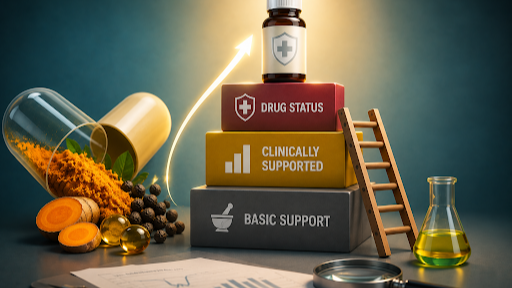
That ladder used to matter most to the formulator. The buyer who read the dossier sat in B2B, and the shopper was assumed to want a nice bottle and a familiar word. The survey data says the shopper is moving toward the formulator's habits. The word that sells at the shelf is now the same word a regulator will check, so the seller's incentive runs toward the stronger claim. The ingredient premium is already visible in licensing prices. The consumer premium is so far mostly something people report in surveys. The argument is that the second is following the first, one layer downstream.
The skincare version
Skincare runs a softer version of the same game. "Cosmeceutical" and "derma-grade" sound like regulatory tiers and have no definition in US law, which leaves them as marketing words. The Food, Drug and Cosmetic Act draws the legal line: a cosmetic cleanses or beautifies, and a product that claims to change how the body works counts as a drug. A cream sold as boosting collagen synthesis has made a drug claim by that test. The careful brands either fund the evidence or stay with what users report feeling.
The data that gets cut first
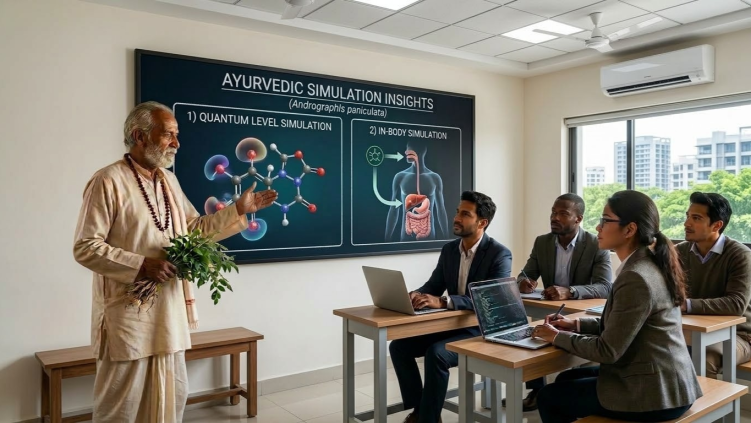
Under each rung is the work budgets cut first when they tighten: characterization and pharmacokinetic data. It means knowing what is in the extract and how much of it gets absorbed. It also means knowing which constituent drives the effect and the concentration where that effect starts. Without it a company cannot design a trial precise enough to win a stronger claim. It cannot specify a batch tightly enough to pass a regulator or tell whether its own absorption number reaches a level that does anything. That work is most of what we do at Formulaite. The commercial case for it used to sit upstream with the formulator. The consumer data now points the same way at the shelf.
The cost of skipping it
Airborne is the downside version of all this. For years it sold a cold tablet on the words "clinically proven" and could not show the FTC what they rested on (FTC, 2008). The characterization that stays off the label is easy to defer and costly to skip. Airborne paid for skipping it in a single $30 million settlement. For most brands the cost is quieter and ongoing, showing up in the pricing power a stronger evidence base would have bought them.
References
Sources: McKinsey & Company. The Future of Wellness (2024). Radicle Science / UC San Diego. Consumer study on "clinically proven" claims (2023). Anand P, et al. Mol Pharm (2007). CRN. 2024 Consumer Survey on Dietary Supplements (Ipsos). Cuomo J, et al. J Nat Prod (2011). Shoba G, et al. Planta Med (1998). DSHEA, Pub. L. 103-417 (1994). FTC. Health Products Compliance Guidance (2022). Liv.52 Phase IV study. Cureus (2024). Himalaya Wellness Company (FY22 figures). FTC v. Airborne (2008).