You've finally nailed the curcumin formula after months of work. The taste is clean, COGS hit target, and you send it to stability at 40°C/75%RH. Six weeks later the lab calls: failed spec. Your Q3 launch just became next year and you're reformulating from scratch with no idea if version two will survive either.
This happens constantly in nutraceutical R&D and it's preventable. Every stability failure costs months because you can't speed up the chamber, and most brands cycle through multiple failures before they land a winner. That's close to a year of dead time while your market window closes.
The Problem: Stability Testing Only Tells You What Went Wrong After It's Too Late
Traditional workflow looks like this: formulate with a phospholipid carrier for bioavailability, add ascorbic acid because someone said curcumin oxidizes, mix it, capsule it, send it to the chamber. You've already ordered materials and started artwork before you know if the chemistry actually works.
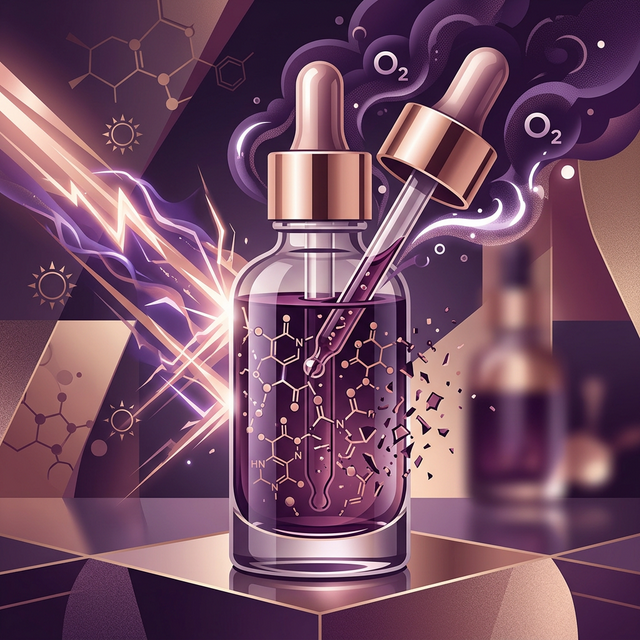
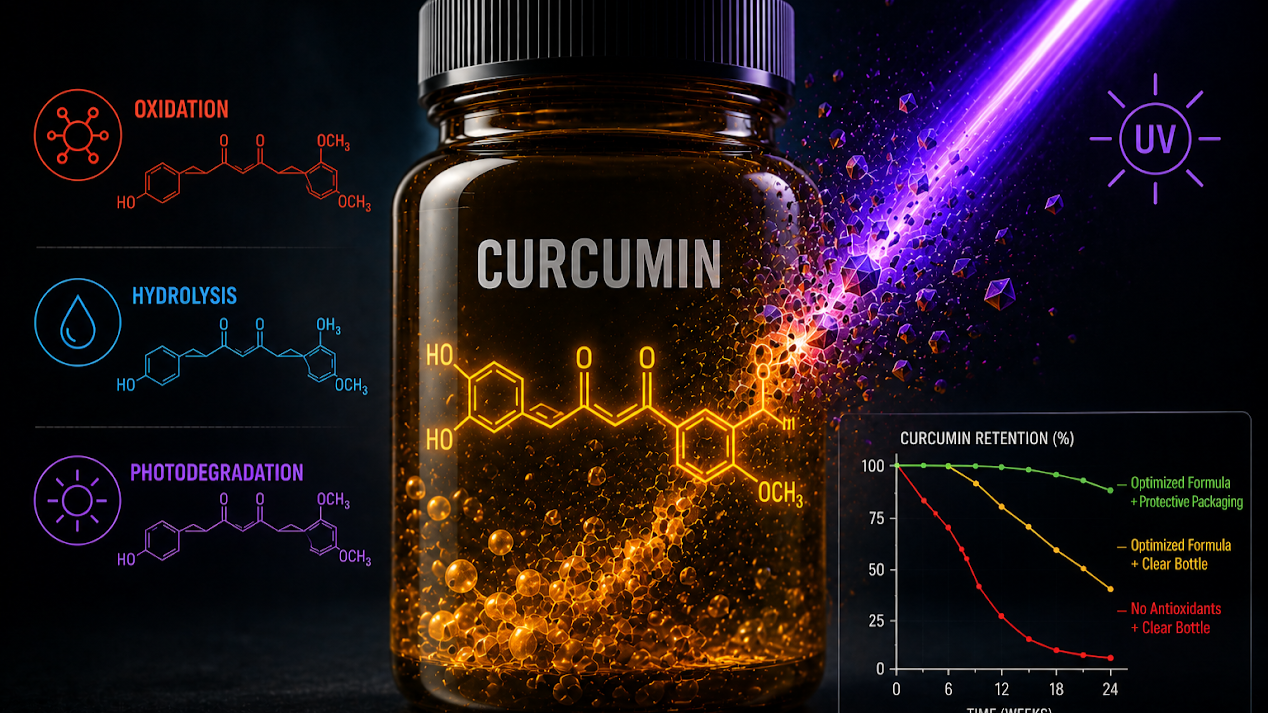
Most stability failures are chemically predictable before you mix anything. Curcumin degrades through radical autoxidation, direct oxidation, photodegradation, and hydrolysis. If you're using ascorbic acid in an oil-based formula you need to know whether it's actually reaching the curcumin in the oil phase or sitting uselessly in water. That's a physics problem with a physics answer, but you only get the answer months later when it's expensive to fix.
The Solution: Run the Failure in Software First
Computational stability modeling calculates degradation before you touch a beaker. Our engine uses quantum chemistry to calculate bond dissociation energies and Arrhenius equations to model how each degradation pathway runs at different temperatures and storage conditions. You input your carrier, antioxidants, packaging specs, and the model tells you which version survives before you order materials.
We tested this against published experimental data on curcumin with different antioxidants including Trolox, ascorbic acid, and ascorbyl palmitate. Our simulation predicted the exact experimental ranking without any calibration. More insightful than the ranking was the pathway breakdown showing that adding strong antioxidants completely flipped the failure mode from radical oxidation to photodegradation, which means you need different packaging strategies depending on your formula.
Packaging Can Matter More Than the Formula
We ran another stability analysis comparing commercial curcumin products using crystalline extracts, phospholipid complexes, and polymer dispersions. The HPMC formula with dual antioxidants in capsules performed well, while the phospholipid complex without antioxidants struggled.
Strip the capsule shell from that phospholipid formula and put it in a clear bottle? Stability crashed because photodegradation spiked when the liquid carrier got light exposure. Switch to aluminum blister packs? Stability jumped over 60% from packaging alone.
The simulation lets you test packaging scenarios before you commit to tooling. If your formula uses a liquid carrier without antioxidants, you can't afford to guess on bottles or nitrogen purging.
Why This Actually Saves Time
Each stability study takes months to complete. Fail once and you're reformulating then waiting another six months for the next round of data. Run the simulation first and you know which antioxidant system works and which packaging material you need before you mix batch one. You still run the physical study because regulators require it, but you're validating a prediction instead of hoping for luck.
Stability failures aren't bad luck, they're predictable chemistry you can model before touching a beaker.